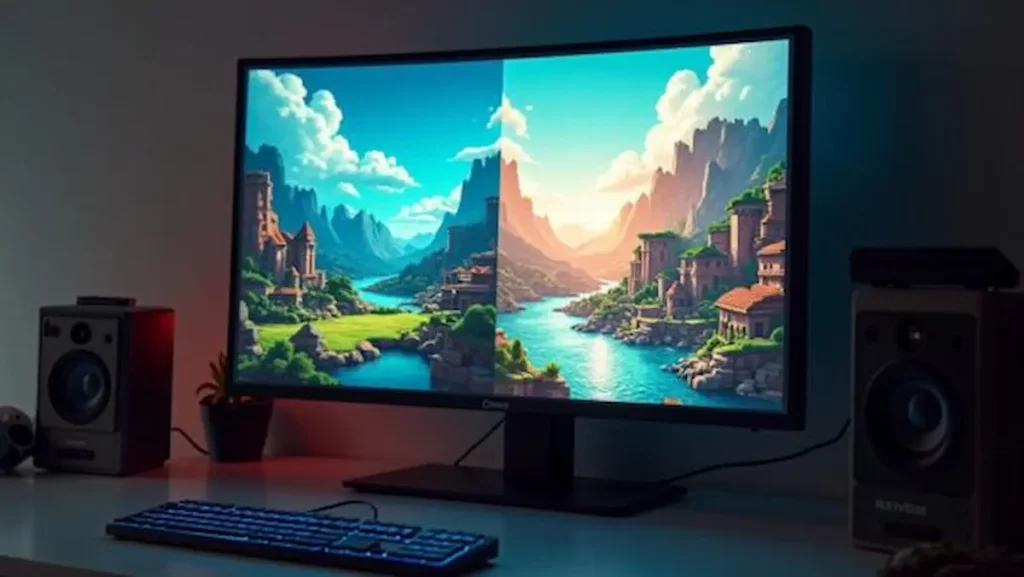
Gaming graphics have undergone one of the most remarkable evolutions in entertainment history. What began with simple pixel blocks and limited color palettes has transformed into hyper-realistic environments capable of rivaling film-quality visuals. From 8-bit characters to near-photorealistic worlds rendered in real time, each generation of gaming technology has pushed boundaries, reshaped player expectations, and redefined immersion.
This journey is far from over. As artificial intelligence and real-time ray tracing continue evolving, gaming graphics are poised to enter a new era where creativity and technology merge in unprecedented ways.
Early Beginnings: The Era of 8-Bit and 16-Bit Graphics
The foundations of modern gaming were laid during the 8-bit and 16-bit eras, where creativity had to overcome severe hardware limitations.
Despite small color palettes and restricted processing power, developers used pixel art and sprite animation to tell compelling stories. These games drew players into imaginative worlds, proving that emotional impact didn’t depend on realism but on artistic intention.
Titles like Super Mario Bros., The Legend of Zelda, Sonic the Hedgehog, and Street Fighter II became cultural landmarks because their visual design was iconic and memorable. Animation techniques such as exaggerated poses, looping cycles, and vibrant backgrounds were essential for bringing characters to life.
Many of today’s indie developers still draw inspiration from this era. Retro-themed games show how well-crafted pixel art can transcend technology, illustrating that innovation often comes from constraints.
The Rise of 3D Graphics in the 1990s
The 1990s marked a groundbreaking shift in video game visuals. The transition from 2D sprites to 3D polygon-based graphics revolutionized how developers built worlds.
Suddenly, players could move through fully realized spaces, exploring environments with depth, perspective, and immersive scale. Games like Doom, Super Mario 64, Tomb Raider, and Final Fantasy VII showcased what 3D graphics could achieve.
Key advancements included:
- Polygon modeling, allowing characters and environments to have shape and form.
- Texture mapping, which added details to surfaces.
- Early lighting techniques, giving worlds more atmosphere.
- Camera control, which gave players a new sense of agency.
This technological breakthrough set the foundation for modern visuals. Even though early 3D models now look primitive, they were revolutionary at the time and opened paths for countless innovations that followed.
Advancements in Real-Time Rendering Techniques
As technology progressed, developers refined real-time rendering techniques to deliver increasingly complex and cinematic visuals during gameplay—not just in cutscenes.
Game engines such as Unreal Engine, Unity, CryEngine, and Source introduced new graphical capabilities, including:
Dynamic Lighting
Lights could shift, flicker, and adapt to movement, transforming the mood of entire scenes.
Shadow Mapping
Shadows became more realistic, reacting to objects, characters, and environmental changes.
Shader Programming
Materials like metal, skin, water, and fabric could behave and reflect light realistically.
Normal and Bump Mapping
Flat textures gained depth, making surfaces look rough, smooth, or layered.
These rendering techniques helped games achieve near-cinematic visuals while maintaining performance. They also enabled developers to craft distinct artistic styles—from cel-shading in The Legend of Zelda: The Wind Waker to gritty realism in Call of Duty.
The Impact of Hardware Improvements on Visual Fidelity
Hardware advancements have always played a crucial role in the evolution of gaming graphics. Every leap in GPU power, memory bandwidth, and processor speed has enabled developers to push fidelity further.
Modern systems allow:
- 4K and 8K textures
- High frame rates (60–120 FPS)
- Advanced particle systems
- Realistic reflections and refractions
- Lifelike animations powered by motion capture
As graphics cards continue to evolve, players can enjoy smoother gameplay and more detailed environments than ever before. Technologies such as DLSS, FSR, and XeSS also optimize performance through AI upscaling, making high-end visuals accessible on a wider range of hardware.
The Role of Artistic Direction in Game Design
While technology fuels progress, artistic direction gives games their soul.
A game’s look isn’t defined solely by its graphical power—it’s defined by the choices artists make: color palettes, environments, character design, lighting moods, and thematic details.
Some visually iconic games rely on style rather than realism:
- Hollow Knight uses hand-drawn art to evoke emotion.
- Journey relies on soft lighting and minimalism to convey serenity.
- Cuphead embraces 1930s animation to stand out.
- Fortnite uses a bright, cartoon-like aesthetic to appeal to broad audiences.
Strong artistic direction ensures that visuals support storytelling and gameplay. Even with unlimited power, graphics must serve a purpose—and great games use art to deepen immersion and emotional connection.
Photorealism and the Quest for Immersive Experiences
Modern gaming inches closer to total realism with each generation.
Real-time ray tracing simulates how light behaves in the real world, creating lifelike reflections, shadows, and global illumination. High-resolution textures, advanced skin shaders, and cinematic animations round out the experience.
When done well, photorealism enhances immersion:
- Environments feel more authentic.
- Characters appear expressive and believable.
- Player emotions deepen as visuals mirror reality.
Games like Red Dead Redemption 2, Cyberpunk 2077, The Last of Us Part II, and Microsoft Flight Simulator demonstrate how artistic vision and cutting-edge technology combine to create breathtaking experiences.
Future Trends: AI and Beyond in Gaming Graphics
The next evolution of gaming graphics is already underway—and AI is leading the charge.
AI-Generated Textures
Developers can generate detailed environments faster, reducing labor and improving visual quality.
Procedural Worldbuilding
Entire landscapes can be created automatically, giving players larger, more dynamic worlds.
Smart Upscaling and Frame Generation
AI enhances resolution, smooths animations, and boosts performance.
Real-Time Ray Tracing Advancements
New hardware will make cinematic lighting standard across platforms.
The future points toward even more immersive and intelligent visuals, where worlds not only look real but react dynamically to player behavior.
Conclusion
Gaming graphics have evolved from simple pixel art to astonishingly realistic virtual worlds. Each era—8-bit beginnings, 3D revolutions, shader innovations, and now AI-driven advancements—has contributed to a richer, more immersive gaming experience.
While technology drives these leaps, artistic direction ensures visuals retain meaning, style, and emotional impact. As AI, ray tracing, and powerful GPUs continue to advance, gaming graphics will push toward new levels of realism, creativity, and interactivity.
The journey from pixels to photorealism is far from over—and the next chapter may reshape gaming in ways we’ve only begun to imagine.
Amanda has a degree in Languages, is a postgraduate student, and is passionate about content creation. After joining Cenário Capital, she discovered a strong interest in games. She currently works on the Marketing team, in the SEO and Content squad.