The debate around Nintendo Switch OLED vs. regular Switch always comes down to one key question: how do you play? At first glance, both consoles look nearly identical, but the OLED model introduces subtle upgrades that significantly impact handheld and tabletop gaming. With a brighter screen, deeper colors, improved audio, and a sturdier overall build, it delivers a more premium portable experience.
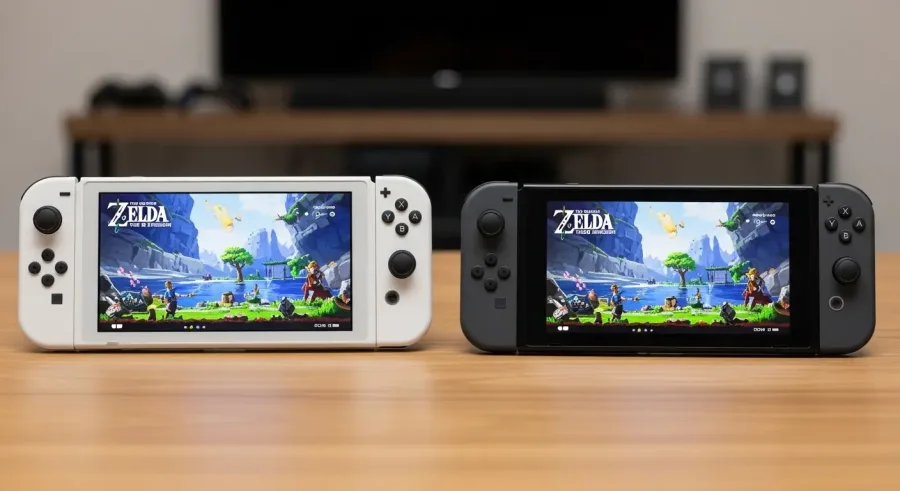
The Nintendo Switch OLED vs. regular Switch comparison highlights clear wins for handheld gamers. (Image: ABWavesGame)
But does that make it worth the higher price? Or does the original Switch still offer the best value for most players? This detailed comparison breaks down everything you need to know so you can confidently choose between the Nintendo Switch OLED and the regular Switch.
One of the biggest distinctions in the Nintendo Switch OLED vs. regular Switch comparison is the display.
The regular Switch features a 6.2-inch LCD screen, which is functional and reliable, but not particularly impressive by today’s standards. Colors appear flatter, blacks look more like dark gray, and outdoor visibility can be challenging.
The Nintendo Switch OLED, on the other hand, includes a 7-inch OLED display that immediately stands out. OLED panels produce:
Richer, more accurate colors
True blacks, giving scenes greater contrast
Higher brightness, improving visibility in bright rooms or outdoor settings
A larger, nearly edge-to-edge screen, enhancing immersion
Even though the resolution remains the same, the overall visual experience feels significantly more polished.
For players who spend most of their time in handheld mode, the display upgrade alone can make the Nintendo Switch OLED feel like a completely different console.
Audio enhancements and speaker performance
Another area where the Nintendo Switch OLED vs. regular Switch comparison tips in favor of the OLED model is sound quality.
Nintendo redesigned the speakers on the OLED Switch to deliver:
Clearer vocals and sound effects
Stronger midrange audio
Less distortion at higher volume
More immersive output for handheld and tabletop gaming
While the regular Switch’s speakers get the job done, the audio feels noticeably flatter and less dynamic when compared side-by-side.
This makes the OLED model especially appealing for players who enjoy handheld gaming without headphones. Whether you’re exploring atmospheric RPGs, playing intense shooters, or enjoying Nintendo classics like The Legend of Zelda or Mario Kart, the improved sound adds depth to every moment.
Design and build: materials and durability
When examining the Nintendo Switch OLED vs. regular Switch from a design perspective, the difference in build quality becomes clear.
The regular Switch has a functional but somewhat flimsy stand that only supports one angle, making it less stable for tabletop gaming.
The Nintendo Switch OLED, however, features:
A wider, full-length adjustable kickstand
Greater stability on any flat surface
Improved hinge strength
A more premium feeling due to slightly upgraded materials
These improvements make tabletop mode far more enjoyable and reliable, especially for multiplayer sessions or gaming on the go.
Despite the enhancements, the weight difference between the two models is minimal, and both remain highly portable. The OLED model just feels more refined, with small ergonomic touches that make everyday use smoother and more satisfying.
Battery life and charging capabilities
Surprisingly, battery life is nearly identical between the Nintendo Switch OLED and the regular model (the updated 2019 revision).
Both systems offer:
Approximately 4.5 to 9 hours of battery life, depending on the game
USB-C charging for easy use with portable chargers
Similar power consumption in docked and handheld mode
This means neither console has a clear battery advantage. However, because the OLED screen is more efficient with darker colors, some games may slightly favor the OLED model in real-world usage.
Regardless, both versions perform well for long handheld sessions, making battery life a neutral factor in the Nintendo Switch OLED vs. regular Switch decision.
Pricing and value for money comparison
Price is often the deciding factor when choosing between the Nintendo Switch OLED vs. regular Switch.
The OLED model costs more, and the upgrades focus heavily on the handheld experience rather than raw performance. Both consoles run games at the same frame rate and resolution, and docked gameplay remains virtually identical.
Choose the Nintendo Switch OLED if:
You play primarily in handheld or tabletop mode
Display quality matters to you
You want richer colors and deeper contrast
You want better sound without relying on headphones
You appreciate a stronger, more adjustable kickstand
You want a more premium-feeling device
Choose the regular Nintendo Switch if:
You mainly play docked on a TV
You want to save money
You don’t mind the smaller LCD screen
You prefer the most budget-friendly option that still delivers full Switch performance
For players who use their console mostly on the TV, the regular Switch remains a strong value because both models perform the same in docked mode.
Conclusion
The comparison between Nintendo Switch OLED vs. regular Switch highlights that the OLED model offers clear advantages — especially for handheld gamers. With its vibrant 7-inch OLED screen, richer colors, true blacks, improved audio, and sturdier build, the Switch OLED provides a premium portable gaming experience that feels more modern and immersive.
Both models share the same performance, battery life, and game library, but the OLED stands out where handheld gaming matters most. If you primarily play in handheld or tabletop mode, the OLED model is absolutely worth the upgrade. But if you spend almost all your time playing on the TV, the regular Switch remains a great value for the price.
In the end, choosing between the Nintendo Switch OLED vs. regular Switch depends entirely on your play style — and now you have everything you need to make the right choice.